
The Future Looks Bright at First Glance
As for the Present, it’s Far Better than it Appears

The Future
Imagine, if you will, a Goldilocks Economy... in the Year of Our Lord 2042.
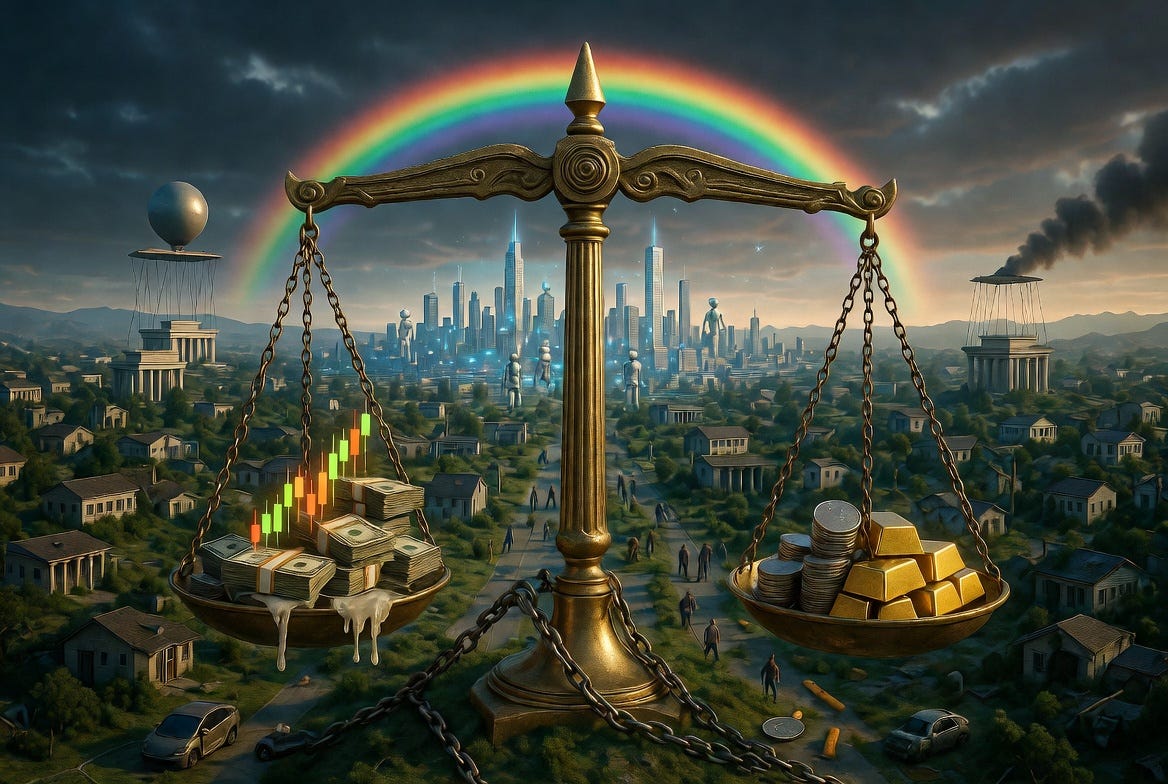
The joint is humming. Housing has finally become affordable again for the beleaguered remnants of the middle class—after two decades of the AI-robotics miracle and that blessed technology-labor accord that somehow didn’t end in serfdom.
Inflation? A ghostly 0% ex-food and energy, that official statistical fairy tale we all pretend to believe. The world has been at peace since those pesky Middle East and Ukraine dust-ups were wrapped up in 2032 with treaties so equitable they practically sang Kumbaya. No more forever wars draining the treasury and the soul.
Global trade has settled into a shiny new multipolar arrangement, courtesy of the controversial Mar-a-Lago Accords of 2027. Gold as settlement currency!
Triffin’s dilemma slain like a dragon. No single hapless empire left holding the bag as world reserve issuer. Reindustrialization is kicking in.
Productivity is soaring. Employment participation? Haven’t seen rates this high since the Boomers were young and deluded.
Wages, by some miracle of central planning, mostly keep pace with the gentle upward creep of grocery and gasoline tabs. It’s an economic miracle, dear reader. Pass the soy latte and praise the models.
Yet here we are, more than fifteen years after the all-time highs of late 2026 and early 2027, and the stock market has delivered a soul-crushing 2-4% annualized return.
That’s after the 1987-style one-day face-plant in fall 2027. No fresh highs in over a decade. Bitcoin, having scraped bottom at 22,000 in late 2026, has spent the intervening years moldering between 25k and 35k like a forgotten houseplant.
Gold and silver bugs? They’ve enjoyed their steady 5% annual crawl—nothing to storm the Bastille over.
Meanwhile, oil trades at a robust $150 a barrel, even with peace breaking out like acne on a teenager.
Gasoline? North of six bucks a gallon at the pump, nationwide. Food prices climb 5-7% a year like clockwork. Real estate, after that invigorating 50% haircut during the ‘27 crash, barely budges.
Interest rates remain stubbornly locked in double digits, because reasons. The financial priesthood intones the sacred mantra: “Markets don’t reflect the real economy. Be grateful you have a job, a roof, and kale that only costs twice what it did last decade.”
People shuffle along, vaguely uneasy. Bitcoiners (except the die-hard Maxis) have quietly euthanized their Lambo dreams.
Gold bugs shrug—they’re used to being early and wrong for decades.
Workers mutter about gas and groceries, but touch wood that the jobs hold.
None of it computes.
Sixteen years ago, when World War III was knocking politely at the door, the Strait of Hormuz was blocked for months, crude lounged below $70, and gas was under four bucks.
Stocks were printing fresh all-time highs like it was their job. Bitcoin loitered above 50k.
Interest rates? A quaint 5%. The financial commentariat called it “resilience.”
Now? Peace, productivity, and prosperity... and the assets act like they’re in mourning.
The narrative from the financial sphere grows ever more hallucinatory: “Be happy with stability.”
The die-hard dissidents, those bitter clingers, pine for the good old days of permanently rigged-to-the-upside markets—housing that only went up, stocks that levitated on cue, dips bought instantly for effortless profits, forever wars, ballooning disparities, and that delicious apocalyptic frisson.
They miss the adrenaline of the zombie-apocalypse economy, where the juice felt worth the squeeze, even as it hollowed out the future.
I get it. This 2042 Goldilocks should be showering the productive with real wealth and upside.
The real economy booms while financial markets squat in the doghouse like sulky teenagers.
Reindustrialization helps on the margin, but the middle class remains stuck, gazing at the distant shores of genuine upward mobility that never quite arrive.
The Present
That future is a thought experiment—an impossibility. Now rewind to our actual timeline, where the opposite absurdity isn’t theoretical; it’s operational.
The Strait of Hormuz gets blockaded for months amid real supply chaos.
Negotiations for basic memoranda of understanding collapse into farce.
Oil should be north of $150, gasoline well over six bucks, inflation raging like a California wildfire, interest rates clawing toward double digits, and risk assets—stocks, real estate—taking a 30-50% haircut as rational actors price in the obvious.
Gold, silver, and Bitcoin? They should be screaming higher as the only honest money left in a hall of distorting mirrors.
Instead? Oil trades near pre-crisis levels. The dollar strengthens like a good little soldier. Equities and property are propped up by narrative fumes and concentrated flows.
The hedges languish. And the man who once correctly called the stock market rigged, along with the official employment and inflation voodoo, now struts and takes credit for the “miracle” while promising even lower oil prices once he finishes winning the wars.
Beautiful. Masterful, even. The financial press nods sagely. Pricing insanity has become the water we swim in—everyone believes it’s normal because the alternative requires admitting the emperor’s leverage is synthetic, the discovery mechanism is broken, and the whole contraption runs on monetary fentanyl, passive indexation, repressed rates, and narrative control by the Financial Industrial Complex.
Price discovery isn’t merely impaired; it’s been euthanized and replaced by a sophisticated puppet show.
Michael Green’s passive investment vortex, endless monetary expansion, and the heavy hand on short rates have unmoored everything from reality.
Capital allocation? A joke.
Incentives? Perverted toward extraction and control.
The current chaos should have cratered the overvalued, yet the bids appear on command. The future boom should ignite the worthy, yet the same machinery will likely keep it tamped down, preserving the grift.
This is not efficiency. This is managed decline dressed in Bloomberg graphics and central bank pressers.
The absurdity on both ends of the timeline reveals the same truth: the pricing mechanism is severed from the real world, and we’re all supposed to pretend the amputation never happened.
Wake up before the phantom limb pain becomes unbearable.
The amputation was performed years ago—we just keep pretending the hand is still typing.
The Long Emergency doesn’t care about your portfolio statements or your political team. It only cares that the books no longer balance—physically, financially, or morally.